
Advantages of OCA (Optically Clear Adhesive) bonding over traditional frame bond (edge tape) bonding for capacitive touch screens
2025/11/3
l Superior optical performance – OCA film is highly transparent (light transmittance>98% and haze<1%). This dramatically reduces internal reflections, boosts brightness and contrast, and improves readability even in strong ambient light.
l Very thin bond line – Sheet type OCA can achieve a bond thickness of only 0.005–0.008 in (≈0.13–0.20mm), far thinner than the 0.015–0.030 in typical of liquid adhesives and much thinner than the air gap left by frame tape. The thin gap enables a slimmer overall module.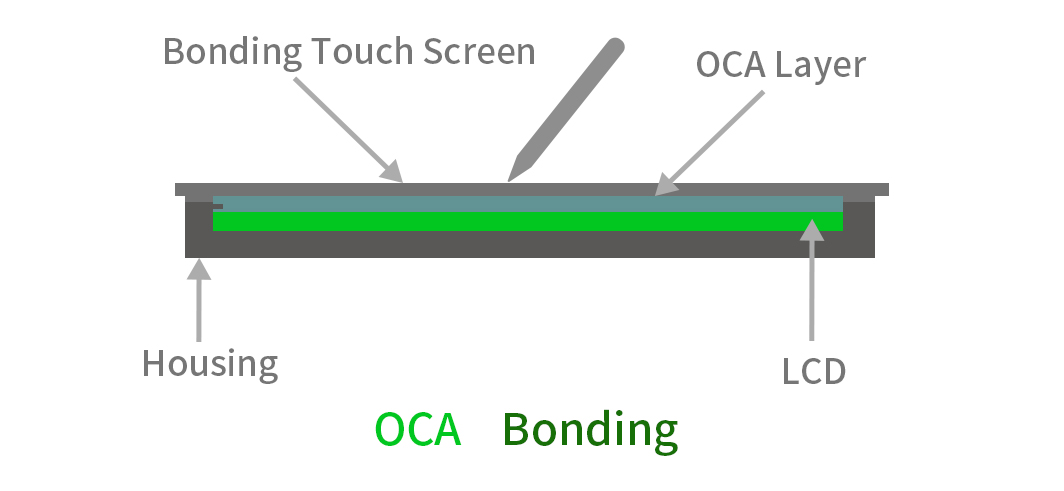
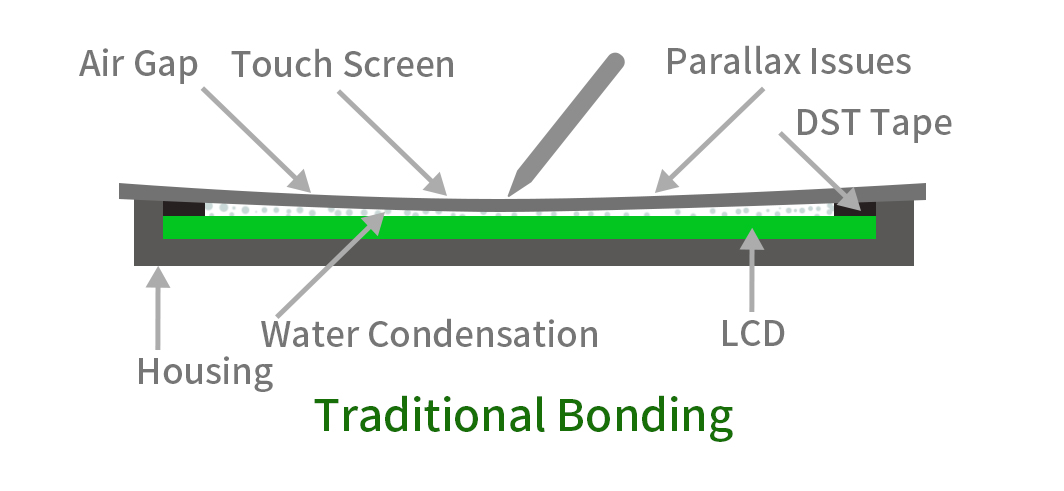
l Enhanced touch accuracy – By eliminating the air gap between the cover glass and the touch sensor, OCA bonding removes parallax and improves capacitive coupling, resulting in more precise touch response.
l Improved durability and shock resistance – The adhesive fills all voids, providing a uniform stress distribution layer that absorbs impact and reduces the risk of glass cracking. It also adds resistance to scratches and mechanical shock.
l Better environmental sealing – OCA creates a hermetic seal that blocks dust, moisture and contaminants from entering the display stack, enhancing long term reliability and enabling higher IP ratings.
l Reduced power consumption – Higher transmittance means the backlight can operate at lower intensity for the same perceived brightness, saving energy.
l Consistent manufacturing quality – As a dry film adhesive, OCA avoids liquid flow and curing variations, delivering uniform thickness and high yield when applied correctly.
l Thin profile device design – The minimal bond thickness allows manufacturers to produce lighter, thinner devices, which is critical for modern smartphones, tablets and wearables.
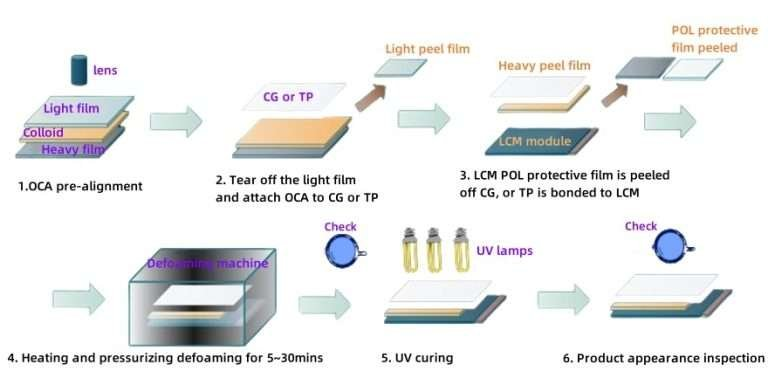
Note: While OCA bonding offers these performance benefits, it typically incurs higher material cost and lower production efficiency compared with simple frame tape bonding, especially for large size panel. The choice therefore balances optical/functional advantages against cost and manufacturing considerations.