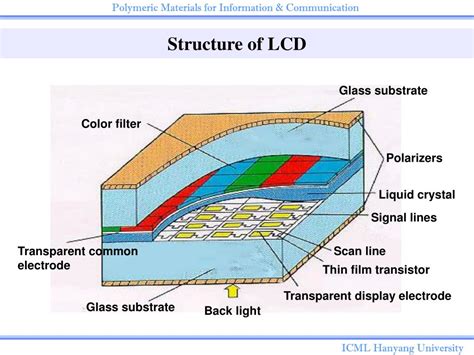
A Liquid Crystal Display (LCD) is a flat-panel technology that forms images by modulating light with liquid crystal material. The basic structure consists of two parallel glass substrates with a liquid crystal layer sandwiched between them. Without an electric field the liquid crystal molecules are aligned parallel to the glass, allowing polarized light to pass; when a voltage is applied the molecules tilt vertically, changing the polarization and thus blocking or transmitting the backlight, which creates the visible pixel pattern.
Key Components
l Backlight: Provides uniform illumination; modern LCDs use LED backlights, while older models use CCFL (cold cathode fluorescent lamps).
l Polarizers: Two orthogonal polarizing plates work with the liquid crystal orientation to control light transmission.
l Liquid Crystal Layer: The active optical medium whose molecular orientation is controlled by an electric field.
l Color Filters: Red, green, and blue sub-pixels on each pixel generate full color images.
l TFT Driver: Thin film transistors (TFT) at each pixel enable fast, precise voltage control, improving response time and image quality.
Typical LCD Types
l TN (Twisted Nematic) – fast response, low cost, limited viewing angles.
l IPS (In Plane Switching) – wide viewing angles and accurate colors, favored for high quality displays.
l VA (Vertical Alignment) – high contrast and deep blacks, common in TVs.
l LED backlit LCD – replaces CCFL with LEDs for lower power consumption and richer colors.
Advantages
l Low power consumption and thin form factor, ideal for portable electronics.
l Mature manufacturing processes keep costs down, leading to widespread use in smartphones, tablets, laptops, monitors, automotive dashboards, and digital signage.
Typical Applications
l Mobile phone and tablet screens.
l Car instrument clusters and infotainment displays.
l Industrial control panels and public information boards.