
Electronic paper (E-paper / E-ink) vs. LCD – Core Differences
2025/11/5
Electronic paper (E paper / E-ink) vs. LCD – Core Differences
|
Aspect |
Electronic paper (E-paper / E-ink) |
LCD (Liquid Crystal Display) |
|
Working principle |
Uses electrophoretic micro capsules: charged pigment particles move up or down under an electric field, changing the visible colour of each capsule. |
Light modulating liquid crystal layer sandwiched between two polarizers; applying voltage rotates the crystals, altering the polarisation of back light that passes through. |
|
Light source |
Reflective – ambient light is reflected by the capsule surface; no back light is required. |
Emissive – requires a back light (LED, edge lit or direct type) to provide illumination. |
|
Power consumption |
Power is only needed when the image is changed; the display is bistable and can hold a picture for weeks or months without power. |
Continuous power is needed to drive the back light and the LC matrix, so standby power is much higher. |
|
Display quality |
Paper like appearance, very wide viewing angle, excellent readability in bright sunlight, low glare. |
Bright, vivid colours but limited contrast in strong ambient light; viewing angle is narrower than E-paper. |
|
Refresh speed / motion |
Slow (hundreds of ms to seconds) – suited for static text or images. |
Fast (millisecond response) – supports video, gaming and complex animations. |
|
Color capability |
Primarily black white; colour versions exist (e.g., black white red or limited three colour) but are slower and less saturated. |
Full colour RGB panels are standard; colour depth and saturation are high. |
|
Thickness & flexibility |
Ultra thin (≈0.1mm) and can be built on flexible plastic substrates, enabling bendable displays |
Typically thicker because of the back light and glass substrates (≈0.5–1mm); flexibility is limited. |
|
Typical applications |
E-readers, electronic price tags, low power signage, smart watches, IoT displays where long battery life and sunlight readability are critical. |
Smartphones, tablets, laptops, TVs, monitors, automotive dashboards – any device needing fast, full colour, video capable output. |
Summary
l E-paper is a reflective, bistable technology that consumes power only during updates, offers paperlike readability and ultra low standby consumption, but is slower and generally limited to monochrome or low?colour content.
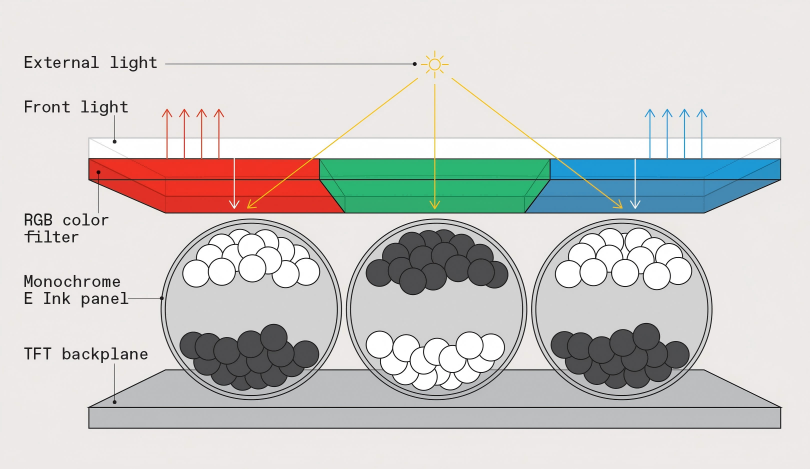
l LCD relies on a back light and electrically controlled liquid crystals, delivering fast, full colour video with higher power draw and poorer sunlight visibility.
These fundamental differences dictate where each technology is best applied.