How to control LCD backlight brightness by PWM
2025/10/16
|
Step |
Description |
|
1. Replace “knob” with “on/off” |
Traditional analog dimming changes the supply voltage, which shifts LED color temperature and reduces efficiency. PWM keeps the LED always driven at its rated current and achieves dimming by rapidly toggling between On and Off states. |
|
2. Key parameters: Frequency & Duty Cycle |
Frequency – how many on/off cycles occur per second (Hz). A value >200Hz is typical so that the human eye’s persistence of vision cannot perceive flicker. Duty Cycle – the percentage of a single period that the LED stays On. Higher duty → higher perceived brightness. |
|
3. Brightness examples |
- 100%: Duty=100%, LED stays continuously on – maximum brightness. - 50%: Duty=50%, LED is on half the time, off half the time – perceived brightness roughly halves. - 10%: Duty=10%, LED lights only 10% of each period – very dim. |
|
4. Advantages |
- Accurate colour: LED always operates at optimal current, avoiding colour?shift seen in analog dimming.- Fine granularity: Duty cycle can be set in 0 -100% steps, often with 256 or more levels.- High efficiency: MOSFETs dissipate little power when fully on or fully off. |
|
5. Drawbacks & cautions |
- Low frequency flicker: Frequencies below ~200Hz may be visible to sensitive users, causing eye fatigue or headaches.- Camera artefacts: Shutter speeds that capture the PWM period produce banding or flicker.- Mitigation: Use high frequency PWM (kHz tens of kHz) or DC dimming (direct current control). DC dimming eliminates flicker but requires additional circuitry to keep colour stable at low brightness. |
|
6. Real world example |
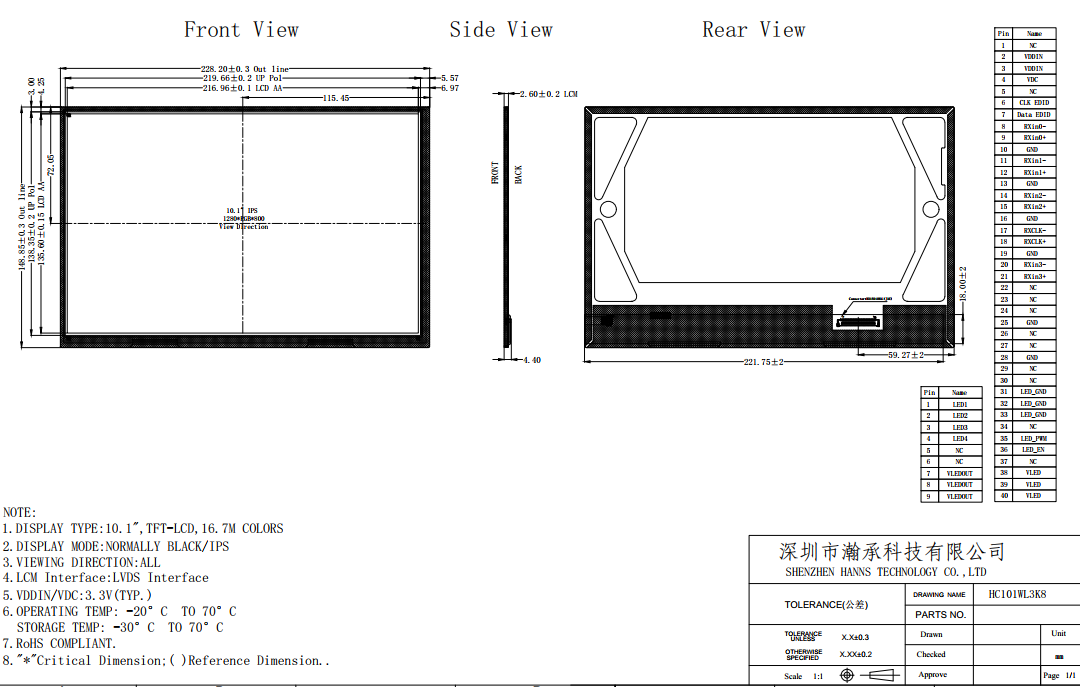
The 10.1 inch industrial IPS panel below already integrates PWM backlight control pins: - Model: HC101WL3K8- Resolution: 1280 ×800- Interface: LVDS- Brightness: 850 nit- Features: high brightness, outdoor use, built in PWM backlight pin |