
TFT-LCD Image Sticking Test Conditions and Generation Mechanism
2025/10/17
1. Overview of LCD Image Sticking
LCD image sticking (also called ghosting or residual image, English term: Image Sticking) refers to the phenomenon where a liquid?crystal display (LCD) module retains the previous static picture after it has been displayed for a long time and the content is changed. The industry typically uses a black?white checkerboard pattern that switches to a uniform gray level for testing.
2. Types of Image Sticking
l By Duration
l Long?term sticking: The display stays on the same picture for an extended period; the residual image recovers slowly or may never disappear.
l Short?term sticking: The display stays on the same picture briefly; the residual image disappears quickly and is generally considered non?defective.
l By Shape
l Area sticking: The residual image appears as a large patch covering a considerable area.
l Line sticking: The residual image appears as thin lines, covering a relatively small area.
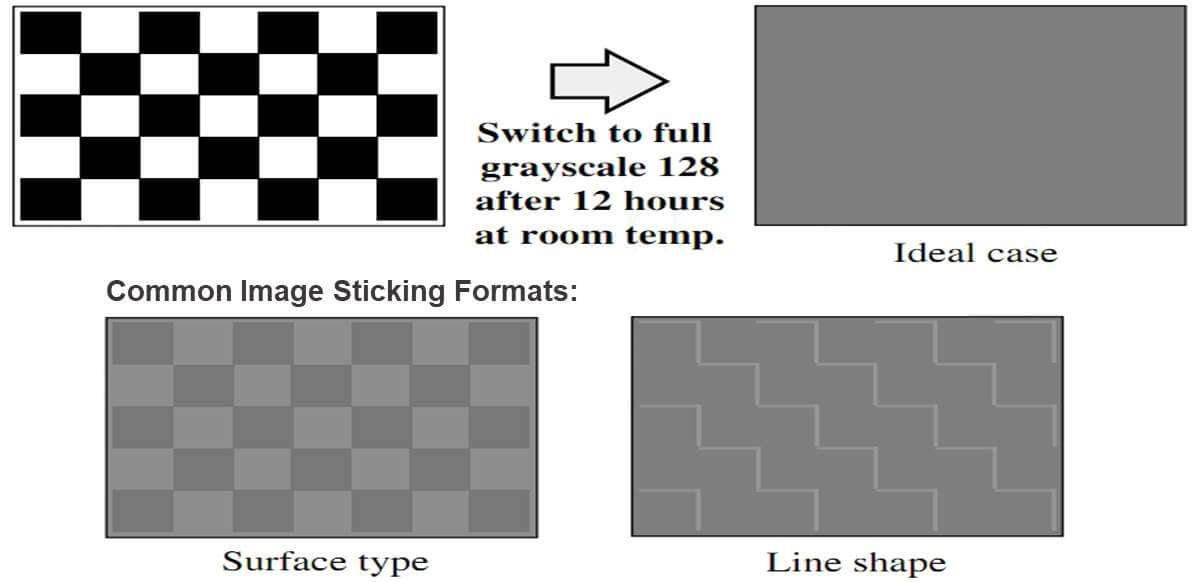
In practice, the most common defect is long?term area sticking, because it affects a large region and persists for a long time.
3. Test Conditions for Image Sticking
The test usually employs a black?white checkerboard (alternating black and white squares) that switches to various gray levels (e.g., L32, L64, L127). Key parameters are:
|
Parameter |
Description |
|
Checkerboard size |
e.g., 6×8, 8×8, 20×20 |
|
Illumination time |
1–2?h at room temperature or a few minutes at high temperature |
|
Ambient temperature |
Room temperature or 70?°C |
|
Gray?level switch |
L127, L64, L32, etc. |
|
Acceptance criteria |
If the residual image disappears within a specified time (e.g., 3?min, 5?s, 5?min), the panel is considered OK |
Different customers define their own standards based on these parameters; testing should follow the specific customer requirements.
4. Mechanism of Image Sticking
1.Ionic impurities
l Ideally, liquid crystal material is a perfect insulator, but in reality it contains trace ionic contaminants. These impurities exist not only in the liquid crystal itself but also in other components such as the PI alignment film, sealing adhesive, and OC planarization layer. When voltage is applied, positively charged ions move toward the negative electrode and vice versa, eventually accumulating at the electrode surfaces.
2.DC offset voltage
l In LCD pixel circuits, a parasitic capacitance (Cgs) exists between the gate and source. When the gate switches from on to off, this capacitance generates a feed?through voltage, creating a small DC offset.
l While an AC driving voltage is applied to the panel, the trapped ions produce a built?in DC offset that makes the positive and negative half?cycles of the voltage asymmetric. This asymmetry causes the liquid?crystal molecules in certain regions to rotate differently from the rest, resulting in visible image sticking.
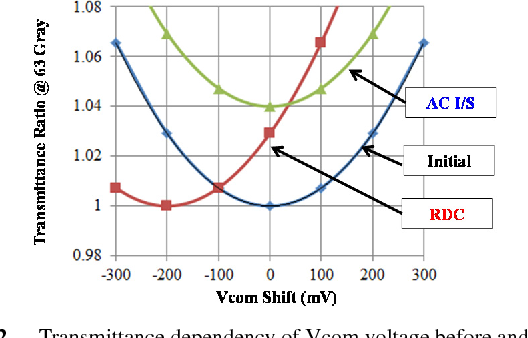
In summary, the coexistence of ionic impurities and the parasitic?capacitance?induced DC offset leads to the formation of LCD image sticking.