
LCD vs. OLED, PMOLED vs. AMOLED
2025/10/23
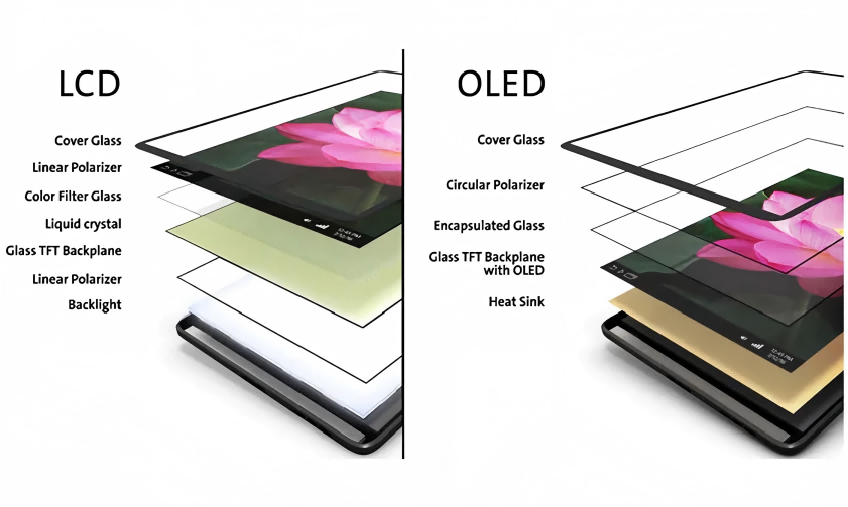
LCD vs. OLED – Core Differences
|
Aspect |
LCD (Liquid Crystal Display) |
OLED (Organic Light Emitting Diode) |
|
Light source |
Requires a back light (LED or CCFL) that shines through the liquid crystal layer |
Each pixel emits light itself; no back light needed |
|
Thickness & flexibility |
Multiple layers (back light, diffuser, polarizers) make the panel relatively thick and rigid |
Very thin, can be built on flexible plastic or metal foil, enabling bendable/rollable designs |
|
Black level & contrast |
Black is produced by blocking back light, so some leakage remains → limited contrast |
Pixels can be turned completely off, delivering true black and theoretically infinite contrast |
|
Color & viewing angle |
Color quality limited by back light uniformity; viewing angle narrower, especially at high contrast |
Emission is Lambertian, giving wide viewing angles (≈180°) and vivid, saturated colors |
|
Power consumption |
Back light is always on; dark images still consume similar power |
Only illuminated pixels draw power, so dark scenes are very energy efficient |
|
Response speed |
Liquid crystal molecules need tens of milliseconds to re orient → noticeable motion blur |
Pixel response in microseconds; virtually no ghosting |
|
Cost & maturity |
Mature, high volume manufacturing; lower cost, especially for large screens |
More complex fabrication, lower yields; price still higher, though narrowing for high volume products |
|
Lifetime & reliability |
Insensitive to moisture/oxygen; long, stable life |
Organic layers degrade with moisture, oxygen, and high brightness; burn in risk and shorter lifetime |
Takeaway: OLED excels in picture quality, thinness, and power efficiency, making it the choice for premium smartphones, wearables, and high end TVs. LCD remains dominant for large, cost sensitive displays (e.g., budget TVs, monitors) where brightness and long term durability are paramount.
OLED Technology – Main Types
|
Type |
Driving scheme / Structure |
Typical applications |
Key characteristics |
|
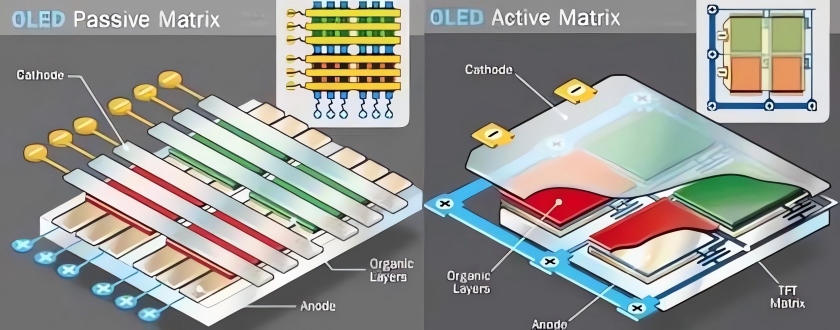
PMOLED (Passive Matrix OLED) |
Rows and columns are addressed sequentially; no storage capacitor per pixel |
Small displays (smart watch faces, car instrument clusters) |
Simple, low cost, but limited size and slower refresh |
|
AMOLED (Active Matrix OLED) |
Thin film transistor (TFT) per pixel stores charge, enabling fast, high resolution panels |
Smartphones, tablets, TVs, VR headsets |
High refresh rates, lower power than PMOLED, more complex & expensive |
|
Transparent OLED (TOLED) |
Uses transparent electrodes and substrates; light can exit both sides |
Heads up displays, retail windows, AR optics |
See through while still emitting light; requires special encapsulation |
|
Top Emitting OLED |
Light exits through the top (often opaque) side; reflective bottom electrode used |
High brightness displays where the substrate is non transparent (e.g., automotive HUD) |
|
|
Bottom Emitting OLED (the classic configuration) |
Light exits through the transparent substrate; most common for phones & TVs |
General consumer electronics |
|
|
Foldable / Flexible OLED |
Built on plastic or metal foil; can be bent or rolled |
Foldable phones, rollable TVs, wearable displays |
|
|
White OLED (WOLED) |
Emits broad band white light; colour filter or colour conversion layers create full color images |
Large area lighting, TV back planes, signage |
|
|
Phosphorescent OLED |
Uses phosphorescent emitters to achieve >100% internal quantum efficiency |
Highefficiency displays, especially for green/red pixels |
|
Summary: All OLED variants share the self?emissive principle, but differ in matrix driving (passive vs. active), emission direction (top vs. bottom), substrate transparency, and form factor (rigid vs. flexible). The choice depends on size, cost, mechanical requirements, and intended use case.
Choosing Between LCD and OLED
|
Scenario |
Recommended technology |
|
Premium smartphones / wearables (thin, vibrant, low power) |
AMOLED / flexible OLED |
|
Large area TVs where absolute brightness in bright rooms matters |
High end LCD (LED backlit) or OLED with local dimming; OLED offers better black but may be dimmer in direct sunlight |
|
Cost sensitive mass market (budget TVs, monitors) |
LCD |
|
Transparent or see through displays (store windows, AR) |
Transparent OLED |
|
Devices needing extreme flexibility or rollability |
Foldable / flexible OLED |
|
Applications where long lifetime and resistance to burn in are critical (industrial control panels) |
LCD |
By aligning the display’s strengths with the product’s requirements, designers can make an informed trade?off between the superior image quality of OLED and the robustness and cost advantages of LCD.