Common solutions for enhancing UV resistance in outdoor LCD modules
2025/12/10
1. Basic Knowledge of Ultraviolet (UV) Light
Ultraviolet (UV) radiation is part of the electromagnetic spectrum with wavelengths ranging from 100 nm to 400 nm, situated between X-rays and visible light. It is invisible to the human eye but carries higher energy than visible light. UV is categorized into three main bands based on wavelength:
For outdoor LCD applications, UV-A is the primary concern due to its high intensity, long-term exposure, and ability to penetrate display components.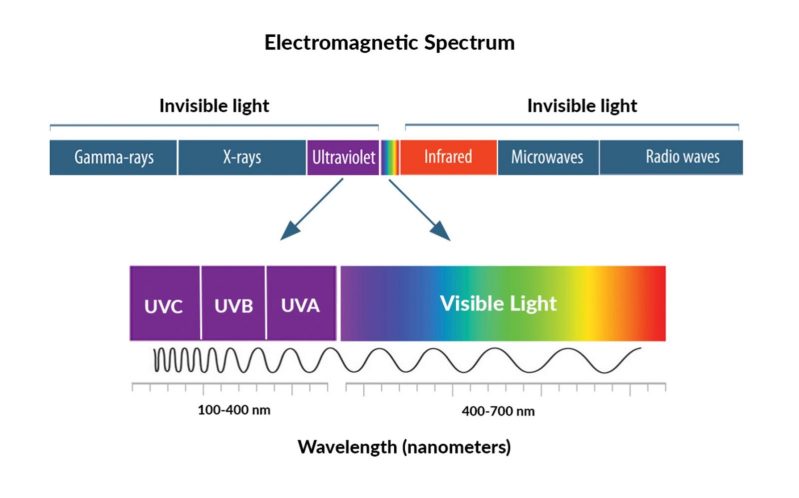
2. How UV Light Affects LCD Displays
LCD (Liquid Crystal Display) panels consist of multiple organic and inorganic layers, many of which are sensitive to UV radiation. Prolonged UV exposure leads to several failure modes:
a) Liquid Crystal Material
- Organic molecules can undergo photochemical degradation or isomerization under UV.
- Result: Reduced birefringence → lower contrast, slower response time, or permanent malfunction.
b) Polarizer Films
- Typically made of PVA (polyvinyl alcohol) sandwiched between TAC (triacetyl cellulose) layers.
-
UV causes:
- Yellowing and dehydration of PVA
- Delamination or cloudiness in TAC
- Significant drop in transmittance and visual clarity
c) Optically Clear Adhesives (OCA)
- Standard OCAs yellow and lose adhesion under UV, leading to delamination, bubbles, or hazing.
d) Color Filters & Encapsulants
- UV degrades dyes and resins → color shift, brightness loss, and reduced image fidelity.
3. Common Solutions for UV Resistance in Outdoor LCD Modules
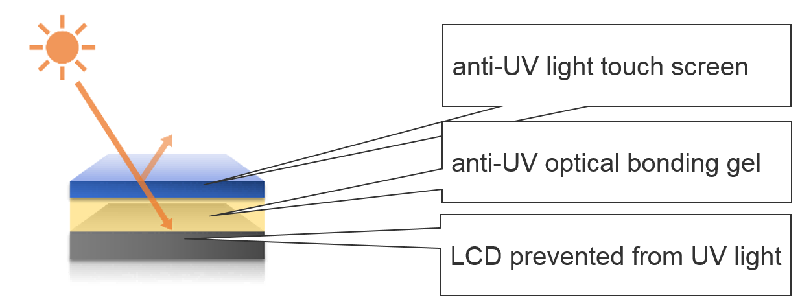
To ensure reliability in harsh outdoor environments (e.g., digital signage, kiosks, transportation displays), manufacturers implement the following strategies:
1. UV-Blocking OCA (Optically Clear Adhesive)
- How it works: Incorporates UV absorbers (e.g., benzotriazoles) that convert UV energy (340–380 nm) into harmless heat.
- Performance: UV transmittance <1%, blocking efficiency >97%.
- Role: Acts as a “sunscreen” for internal layers—prevents UV from reaching polarizers and liquid crystals.
- Adoption: Standard in most outdoor-rated displays.
2. UV-Resistant Polarizers
- Design: TAC layers infused with UV stabilizers or replaced with more stable materials (e.g., COP, PMMA).
- Benefit: Slows yellowing and maintains optical performance over time.
- Use Case: Critical for industrial, automotive, and military-grade displays requiring long life.
3. UV-Cut Cover Glass
- Method: Doped with metal oxides (e.g., CeO, TiO) during manufacturing to absorb UV-A.
- Effect: Blocks >90% of UV below 400 nm while maintaining high visible light transmission (~85–90%).
- Trade-off: Slightly higher cost and potential minor tint (often pale yellow or gray).
- Origin: Technology adapted from automotive windshields.
4. UV-Stable Inks and Housings
- Application: Used for bezel printing, logos, and structural frames.
- Additives: HALS (Hindered Amine Light Stabilizers) or UV absorbers prevent discoloration of white/light-colored parts.
- Importance: Maintains aesthetic consistency and brand image in outdoor installations.
5. System-Level Protection
- Sealing: IP65+ rated enclosures prevent combined UV + moisture/heat degradation.
- Thermal Management: Heat sinks, fans, or automatic brightness control reduce thermal stress that accelerates UV damage.
-
Testing: Accelerated aging tests per standards like:
- IEC 60068-2-5 (UV exposure)
- ASTM G154 (QUV accelerated weathering)
- ISO 4892 (Xenon-arc exposure)